
Rapid Quantum Prototyping (RQP) by qubit-lab.ch
Explore finance use cases with your own data, configurable quantum workflows, classical baselines, and structured outputs.
RQP turns quantum exploration into a workbook-driven business workflow: configure a structured use case, upload or define your own data, run controlled classical and quantum experiments — including against your own baselines — inspect logs and diagnostics, then export reports, raw results, and reproducible notebooks.

What RQP is for
Learning by doing
build real quantum intuition on working workflows, not slides.
Testing your own use cases
your data, your constraints — workbook in, certified report out.
Benchmarking honestly
every quantum result checked by an exact classical referee, and compared against your own existing models if you bring them.
Tuning like a pro
adjust QAOA depth, warm starts, feature maps, and shot budgets — and see the effect on certified results.
Deciding with evidence
stop/go and build-vs-buy backed by certified numbers, not vendor claims.
RQP is a controlled lab: deliberately prototype-scale so the exact referee can certify every result. The evidence decides what is worth building for production — and everything you create stays yours.
Typically used within the six-week RQP Exploration — see the Lean Quantum Exploration process.
RQP in action
Three demos. Every number certified.
Real product sessions on real market data, with an exact classical referee checking every quantum result — including one session driven entirely from an AI chat.
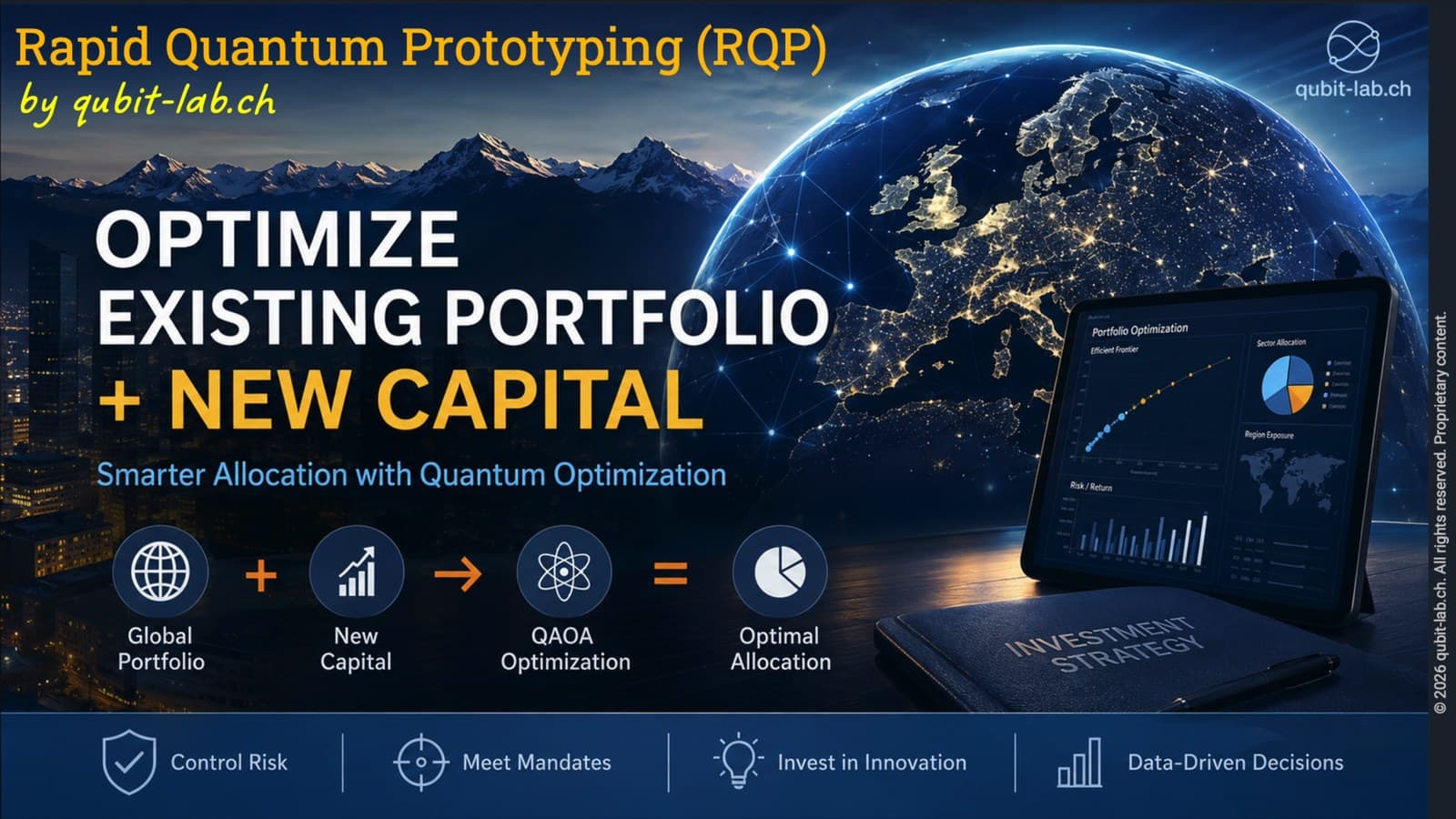 ▶ 4 min
Portfolio Optimization, certified
Existing portfolio + new capital under real mandate rules. QAOA matches the exact solver to the digit.
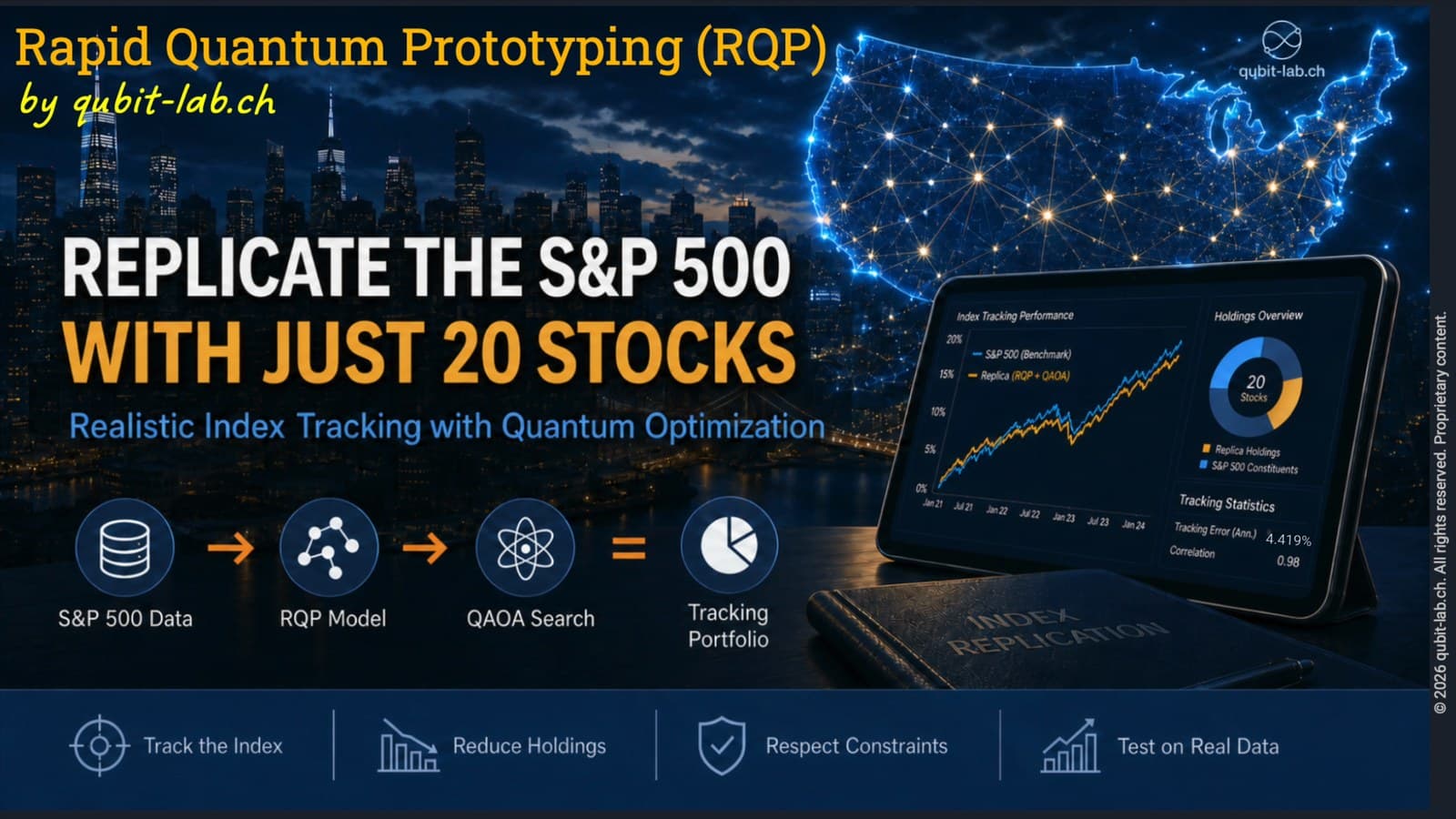 ▶ 2 min
Replicate the S&P 500 with 20 stocks
All 500 names stay in the objective. Every mandate rule priced in tracking error - certified.
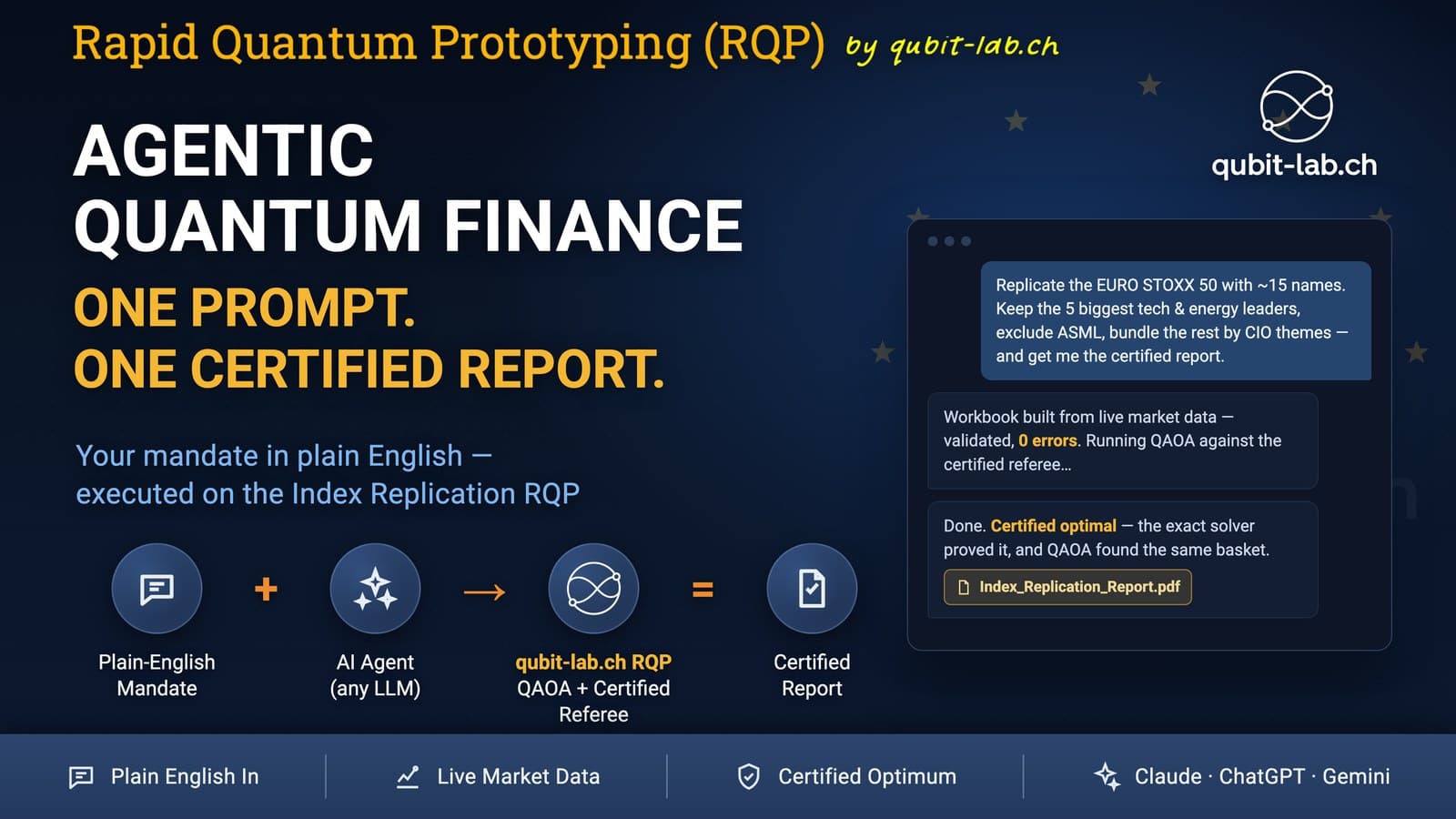 ▶ 4 min
Agentic: one prompt, one certified report
An AI agent builds, validates, and runs the whole workflow from a single plain-English mandate.
Evidence, not promises
The numbers behind the demos — unedited.
Published sample runs, unedited: QAOA matching the certified optimum across 8.4 million portfolios, every S&P 500 mandate rule priced in tracking error, a collateral allocation where the optimum became the most likely readout of the whole register — and the QML run where the honest, measured answer was “not yet”.
Business-case view
Start from the business problem, then test the quantum workflow.
The public RQP view is intentionally use-case led. The quantum method matters, but the first question is whether a relevant business problem can be formulated, tested, benchmarked, and explained in a structured way.
Portfolio optimization and capital allocation
Test constrained allocation, budget rules, risk-return trade-offs, QUBO formulation, QAOA sampling behavior, and classical baseline comparison.
Optimization RQP
QAOA
Index replication and lean tracking mandates
Test compact replication baskets under real mandate rules: fixed holdings, building blocks, exclusions, and type budgets, with a certified optimum and the cost of each rule in basis points.
Index Replication RQP
QAOA / MIQP
Credit portfolio selection and risk transfer
Test batch selection when exposures move as one transaction - book acquisitions, risk-transfer pools, participations: capital budget, sector caps, connected-client bundles, correlated unexpected loss, a certified optimum, and simulated tail metrics.
Credit Allocation RQP
QAOA / MIQP
Collateral allocation and margin optimization
Test cheapest-to-deliver against coverage stability when margin calls land together: locked pre-posted lines, whole-moving pledge pools, venue eligibility and haircuts, concentration limits, a scenario-based cost-vs-stability frontier, and a certified optimum with per-obligation stress metrics.
Collateral Allocation RQP
QAOA / Exact
Credit, fraud, and anomaly classification
Test structured feature sets, quantum feature maps, classifier behavior, suitability diagnostics, and comparison with classical machine-learning baselines.
QML RQP
VQC / QSVM
Client segmentation and behavioral pattern testing
Explore nonlinear pattern-recognition workflows, feature encoding choices, model diagnostics, and benchmark results for segmentation-style problems.
QML RQP
VQC / QSVM
Derivatives pricing and payoff expectation estimation
Test payoff expectation workflows, distribution preparation, sampling budgets, convergence behavior, and amplitude-estimation-style methods.
QMC RQP
QMC / QAE
Risk scenario analysis and rare-event probability estimation
Explore low-probability event estimation, convergence, shot budgets, sampling efficiency, and resource diagnostics.
QMC RQP
QMC / QAE
Scheduling, selection, and constrained optimization prototypes
Test binary or integer decision problems with constraints, penalties, diagnostics, quantum samples, and quantum-classical comparison.
Optimization RQP
QAOA
Why RQP
A practical bridge from use case to quantum evidence.
The advantage is not that every case becomes quantum-ready immediately. The advantage is speed, structure, and comparability: teams can test whether a quantum method is informative before investing in custom implementation.
Quantum methods behind the workflows
The algorithms are used as tools, not as the starting point.
RQP keeps the algorithmic details visible for technical review, but the workflow starts from the business use case, input structure, constraints, diagnostics, and benchmark comparison.
QAOA
Quantum Approximate Optimization Algorithm
Samples candidate configurations and aims to bias probability mass toward low-cost or high-quality solutions. Used for portfolio allocation, risk optimization, scheduling, and constrained selection.
QAOA / MIQP
Index Replication
Selects a compact basket from fixed core holdings, basket-traded building blocks, and single lines, with exclusions and type budgets. An exact solver certifies the optimum and reports the tracking-error cost of every mandate rule.
QAOA / MIQP
Feature Selection
Selects features under business rules classical selectors cannot express - must-include policies, all-or-nothing bundles, exclusive variants, and type budgets conserved natively by an XY mixer. An exact solver certifies every selection, an out-of-sample holdout validates it, and the result ships as a ready-to-run QML package.
QAOA / MIQP
Credit Allocation
Selects which facilities enter the book when exposures move as one transaction - portfolio acquisitions, risk-transfer pools, participations. Connected-client groups decide as one, sector caps bind the combined book, and an exact solver certifies the optimum; the report adds credit metrics (expected loss, unexpected loss, RAROC) and a classical Monte Carlo loss tail.
QAOA / Exact
Robust Collateral Allocation
Allocates free inventory across CCP and bilateral obligations around a locked book: pledge pools move whole, eligibility and haircuts price every pair, concentration limits bind per venue, and a scenario-covariance term trades posting cost against coverage stability. An exact referee certifies the optimum, the risk-cost frontier, and per-obligation stress statistics.
VQC
Variational Quantum Classifier
Tests structured feature sets for classification use cases such as fraud detection, credit scoring, client behavior, and other nonlinear decision problems.
QSVM
Quantum Support Vector Machine
Maps classical data into quantum feature space and applies kernel-based classification. Used to test whether quantum feature maps can improve pattern recognition for anomaly detection, credit scoring, or segmentation.
QMC / QAE
Quantum Monte Carlo / Quantum Amplitude Estimation
Prepares a probability distribution, maps outcomes to payoffs or events, and reads out the expectation using quantum sampling or low-depth amplitude-estimation variants. The lab compares quantum methods against classical Monte Carlo using accuracy, convergence, budgets, oracle calls, and resource diagnostics.
Data handling
Files you upload to the RQP tools are processed on Google Cloud infrastructure solely to run your prototype job and produce the associated results, reports, and exports. Your data is not shared with third parties and is not used for any other purpose. For early evaluations we recommend working with anonymized or synthetic data; specific data-handling, retention, or residency requirements can be discussed as part of an engagement.
Explore the fit
Want to know more about RQP and the qubit-lab.ch offering?
Please get in touch for a short conversation about how Rapid Quantum Prototyping could support your team, help assess relevant use cases, and shape possible next steps for working together.