
5-Day Quantum Capability Kickstart
From quantum concepts to hands-on quantum coding.
The Quantum Capability Kickstart is designed for quant, risk, data science, innovation, and technology teams that want to build practical quantum coding capability. Participants learn the core concepts by writing and running simple quantum circuits, interpreting results, tuning basic quantum algorithms, and using supporting tools such as RQP and LLM-assisted coding to move faster from theory to experimentation. The Kickstart closes with the team's own 3–4 candidate use cases, ready for the RQP Exploration.
Flat team price for up to 8 participants — discussed in the intro call
Format
Five interactive sessions
Each session is about 3–4 hours and combines explanation, coding, walkthroughs, and practical experimentation.
Focus
Quantum coding capability
Participants learn to write, run, inspect, and adapt simple quantum programs, using frameworks such as Qiskit for hands-on coding.
Output
Practical experimentation skills
Participants leave with a working understanding of circuits, simulators, algorithm parameters, result interpretation, and how LLM support can accelerate quantum coding.
What the Kickstart is designed to solve
Many teams have heard about quantum computing, but have not yet made the step from concepts to code. The Kickstart closes that gap. It introduces the mathematical and conceptual foundations, but always connects them back to executable quantum circuits, coding workflows, simulators, algorithm tuning, and practical experimentation.
Typical starting questions
- How do we move from quantum theory to executable code?
- How do qubits, gates, circuits, and measurement work in practice?
- How can we write and run simple quantum programs?
- How do simulators, hardware backends, noise, and shots affect results?
- How can LLMs support quantum coding, debugging, and learning?
Typical outcomes
- ability to read and write simple quantum circuits
- practical understanding of quantum coding workflows
- confidence in interpreting measurements and simulator results
- basic ability to tune and inspect quantum algorithm behavior
- clearer judgment about where deeper prototyping may be worthwhile
Curriculum: five interactive sessions
The structure can be adapted, but a typical Kickstart starts with single-qubit foundations and then moves through interference, entanglement, practical execution frameworks, and key quantum algorithms for finance.
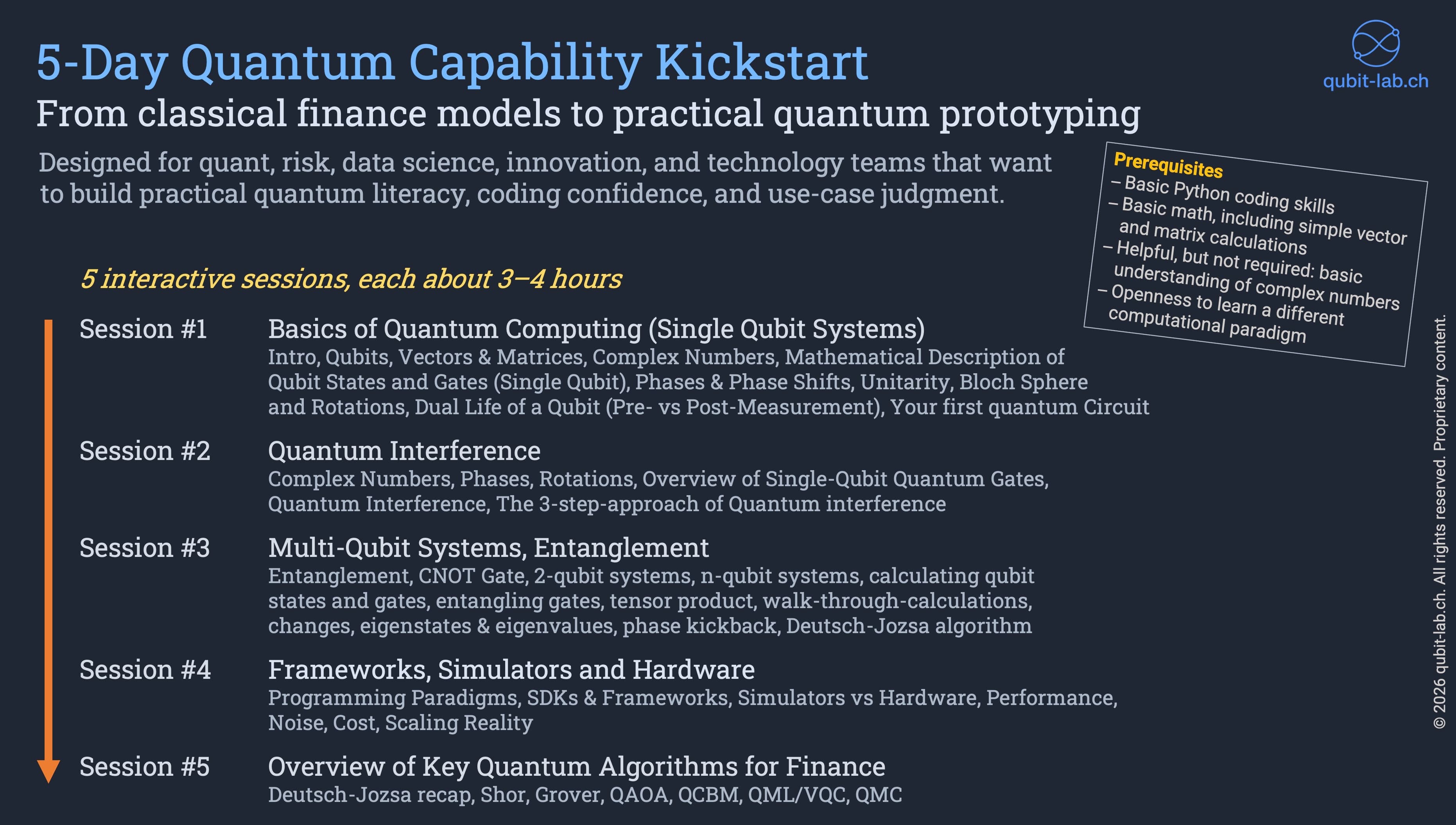
Session #1
Basics of Quantum Computing
Single-qubit systems
Topics
- intro to qubits, vectors, matrices, and complex numbers
- mathematical description of qubit states and gates
- phases, phase shifts, unitarity, Bloch sphere, and rotations
- measurement and the dual life of a qubit
- your first quantum circuit
Outcome
Participants understand the basic mathematical and conceptual building blocks of single-qubit quantum computing and write their first simple circuit.
Session #2
Quantum Interference
Phases, rotations, and interference
Topics
- complex numbers, phases, and rotations
- overview of single-qubit quantum gates
- how quantum interference works
- the 3-step approach to quantum interference
- coding and inspecting simple interference examples
Outcome
Participants understand why interference is central to quantum algorithms and learn how to reproduce simple interference effects in code.
Session #3
Multi-Qubit Systems and Entanglement
Entanglement and multi-qubit logic
Topics
- entanglement and CNOT gates
- 2-qubit and n-qubit systems
- tensor products and walk-through calculations
- entangling gates, eigenstates, eigenvalues, and phase kickback
- Deutsch-Jozsa algorithm
Outcome
Participants understand how multi-qubit systems are represented and how to code, run, and inspect simple entangled circuits.
Session #4
Frameworks, Simulators, and Hardware
Practical quantum execution paths
Topics
- programming paradigms
- Qiskit and other quantum frameworks
- simulators versus hardware
- shots, noise, cost, and scaling reality
- how LLMs can support quantum coding, debugging, and learning
Outcome
Participants understand how practical quantum workflows are executed, how to use quantum frameworks more confidently, and what limits current hardware and simulators.
Session #5
Key Quantum Algorithms for Finance
Finance-oriented algorithm workflows
Topics
- Deutsch-Jozsa recap
- Shor and Grover
- QAOA for optimization
- QCBM and quantum machine learning
- Quantum Monte Carlo and QMC-style workflows
- parameter tuning, diagnostics, and benchmarking logic
Outcome
Participants gain a structured view of key quantum algorithm families and learn how to inspect and tune simple algorithmic workflows.
Where RQP fits in
The Rapid Quantum Prototyping Suite can be included to make the Kickstart more concrete. Instead of discussing quantum algorithms only in theory, participants can inspect workflows, run experiments, compare against classical baselines, review outputs, and use RQP as a structured bridge between training examples and practical use-case exploration.
QAOA
Optimization workflows for portfolio, allocation, scheduling, and constrained selection examples, including parameter choices and benchmark comparison.
VQC and QSVM
Quantum machine learning workflows for classification-oriented examples, including how feature encoding, training, and evaluation are structured.
QMC and QAE
Quantum Monte Carlo and expectation-estimation workflows for pricing, probability, and risk-style examples, including resource and convergence comparison.
Deliverables
five interactive sessions, each about 3–4 hours
a companion Jupyter notebook for every session — 142 runnable code cells in total, with graded exercises and worked solutions
an extended handout for every session — 201 pages in total, each slide reproduced with the explanation that accompanied it in the room
notebooks that run offline on a laptop: no cloud account, no hardware queue, no vendor relationship required
executable quantum circuits and algorithm examples, each checked against a classical reference rather than asserted
common language for business and technical stakeholders
practical understanding of circuits, gates, shots, simulators, and results
introduction to RQP-supported experimentation and benchmarking
guidance on how LLMs can support quantum coding and learning
Course materials
The Kickstart is not a slide deck with a demo attached. Every session pairs a deck with a companion Jupyter notebook, and every participant keeps both. The written material is designed to be readable months later by someone who was in the room — and usable by a colleague who was not.
Companion notebooks
One Jupyter notebook per session, 142 runnable code cells in total. Each cell is numbered to match a slide, so the deck and the notebook can be read side by side. Graded exercises with worked solutions, and nothing that needs a cloud account or a hardware queue — participants can re-run everything the following week.
Extended handouts
One handout per session, 201 pages in total. Every slide that carries an argument is reproduced with the explanation given in the room, plus the common pitfalls, the self-check questions, and the pointer to the notebook cell that verifies the claim.
Verified against classical baselines
Every quantitative claim is stated against a classical referee — the exact optimum where one can be computed, a held-out test set where it cannot. Where there is no quantum advantage to report, the material says so.
See the material before you book
A 23-page sample takes one topic from each of the five sessions all the way through — from the slides that build an idea to the notebook page that makes it executable. The first three assume no physics and can be followed line by line; the last two are the judgement a team needs before spending money on hardware or believing a machine-learning result, including a quantum classifier benchmarked against logistic regression, an SVM and a random forest.
Download the sample (PDF, 23 pages)Prerequisites: are you ready?
No quantum knowledge is assumed. What the course does need is a laptop with a working Python notebook, basic Python, and NumPy vectors and matrices; complex numbers help but are introduced. A short online self-check tells you, and us, what to brush up before the first morning. It is a readiness diagnostic, not an entrance exam.
Take the pre-course self-checkBefore the course
- Setting up your notebook ↗ · PDF, 5 pages
- Ready for the Kickstart? Paper self-check ↗ · PDF, 12 pages
Cheat sheets
- Vectors and matrices ↗ · PDF, 4 pages
- Complex numbers ↗ · PDF, 2 pages
Each operation with its structure, one worked example and the NumPy call. Print them and keep them next to the laptop.
Who should participate
The format works particularly well for teams that combine financial, quantitative, technical, and innovation perspectives. It can also be adapted for a more management-oriented or more technical audience.
- quant teams
- risk teams
- data science teams
- innovation teams
- technology and architecture teams
- business leaders who need a realistic view of quantum coding and experimentation
Prerequisites
- Basic Python coding skills are recommended for participants joining the hands-on parts.
- Basic mathematics, including simple vector and matrix calculations, is helpful.
- Prior understanding of complex numbers is helpful but not required.
- No prior quantum computing background is required.
- The format can be adapted for management, mixed teams, or more technical expert groups.
What this is not
Not a hype session
The Kickstart is explicit about limitations, hardware constraints, benchmarking needs, and the difference between promising research and practical business value.
Not only a theory course
The focus is not only on understanding concepts. Participants are guided toward writing, running, inspecting, and adapting simple quantum programs and algorithmic workflows.
Discuss a Kickstart for your team
A short initial discussion is usually enough to clarify the audience, maturity level, preferred format, and whether the Kickstart should focus more on quantum coding, quantum algorithm understanding, RQP-supported experimentation, or management-level orientation.