
Briefs
The 3-minute versions. Each brief tells one published result in a few slides: the question, the verdict, and what it changes in practice.
Briefs simplify selection and language, never figures — every number is taken verbatim from the linked source, which remains canonical, and briefs are rebuilt whenever a source is revised. The full studies, run records and revision notes live on the evidence page.
The method studies
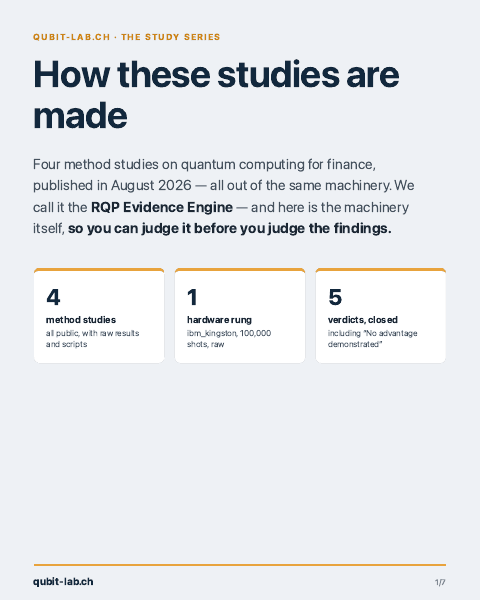
How these studies are made
The machinery behind every study on the evidence page — classical referees, designs locked before the first run, numbers reproduced before printing — and the findings it published against our own products.
7 slides · ~3 minutes
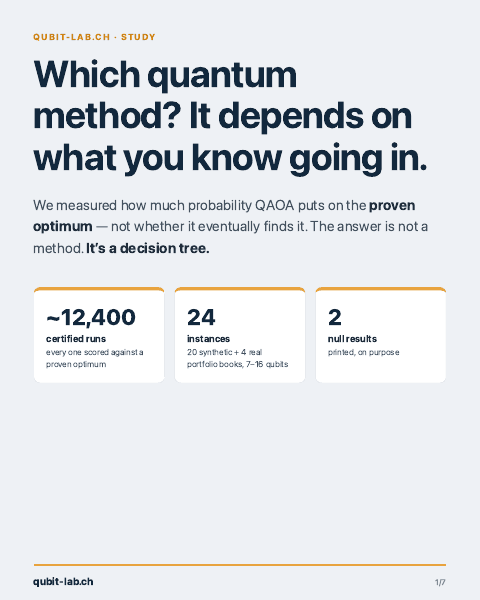
Which quantum method? It depends on what you know going in.
12,397 certified optimization runs. The answer is a decision tree keyed to how much you trust your classical starting point — and it ships as the products' defaults.
7 slides · ~3 minutes
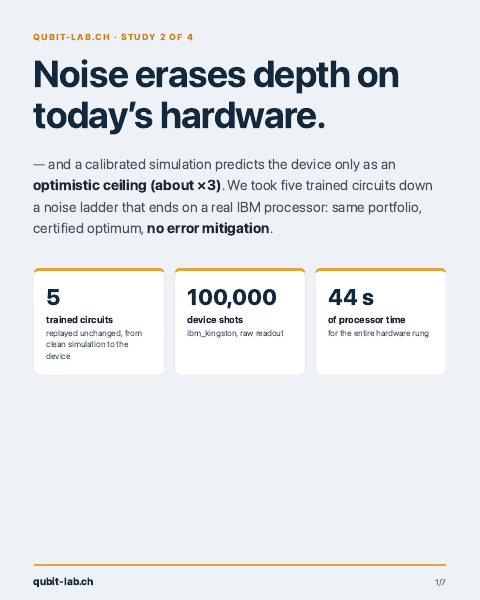
Noise erases depth on today's hardware
Five trained circuits, from clean simulation to ibm_kingston — 100,000 raw shots, 44 seconds of processor time. What survives, and why a calibrated prediction is only an optimistic ceiling.
7 slides · ~3 minutes
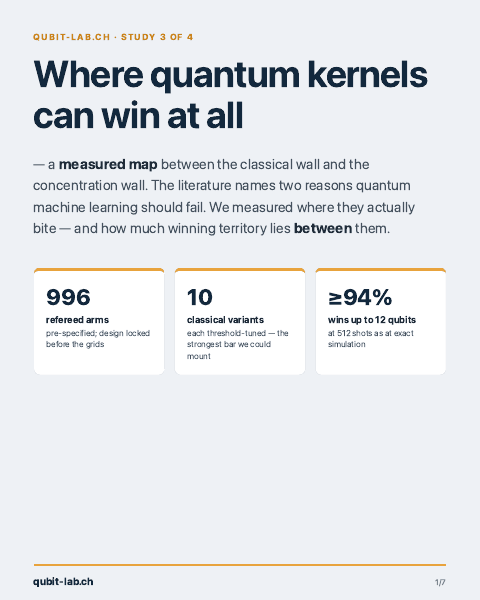
Where quantum kernels can win at all
996 refereed arms map the territory between the classical wall and the concentration wall — a best-case map, honestly labeled, that now ships in the QML product as a printed diagnostic.
7 slides · ~3 minutes
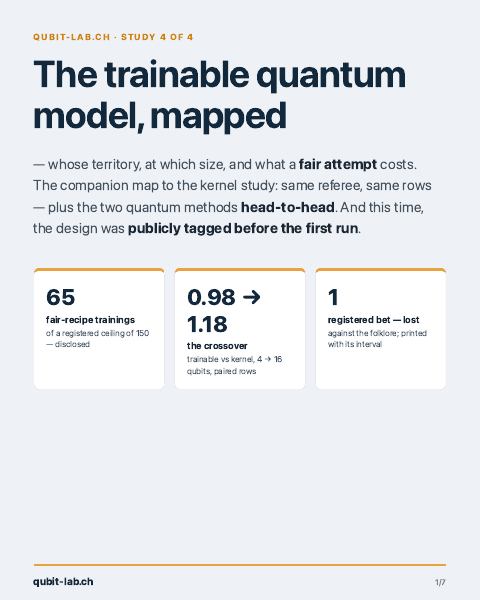
The trainable quantum model, mapped
65 fair-recipe trainings, design publicly tagged before the first run. Whose territory, at which size, what a fair attempt costs — and the bet against the folklore we lost and printed.
7 slides · ~3 minutes
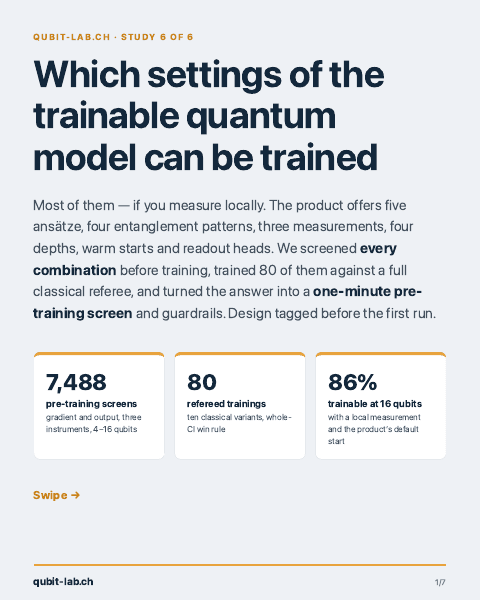
Which settings of the trainable quantum model can be trained
7,488 pre-training screens across every variational configuration the QML product offers, 80 refereed trainings. The product's default region is trainable to 16 qubits and wins on its native labels; one measurement is dead at scale; most structural folklore does not hold — and a one-minute screen now ships in every run.
7 slides · ~3 minutes
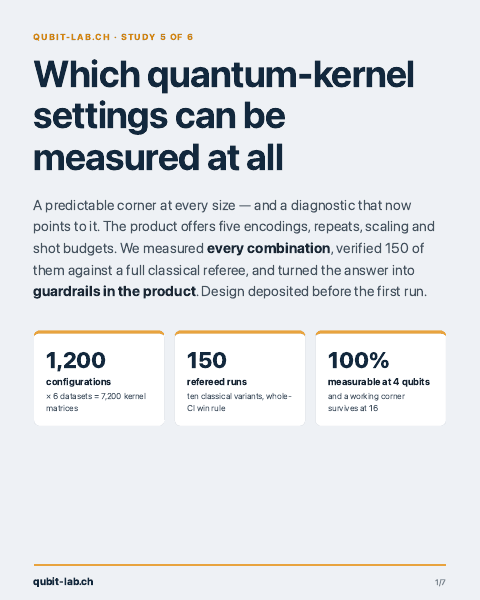
Which quantum-kernel settings can be measured at all
7,200 kernel-concentration measurements across every configuration the QML product offers, 150 refereed. A predictable corner is measurable at every size and the product's diagnostic now points to it; one setting encoded nothing and four apparent wins were classical in disguise — both caught and fixed, the findings shipped as guardrails.
7 slides · ~3 minutes
The case runs
Published sample runs with a certified classical referee — demo data, unedited numbers, caveats printed next to the wins.
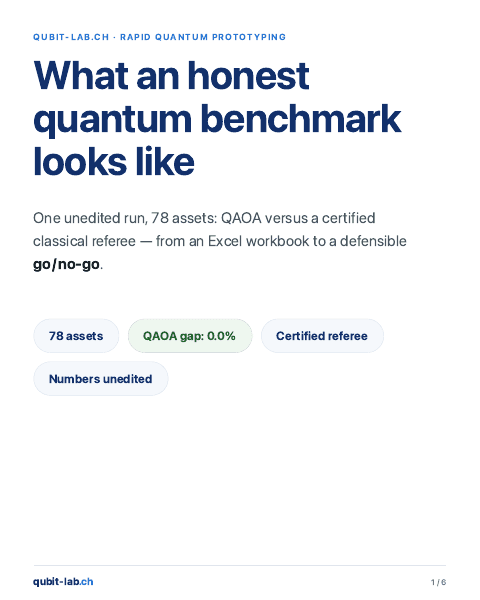
What an honest quantum benchmark looks like
A 78-asset portfolio, 8.4 million allocations enumerated exactly — the quantum result matched the proven optimum bit for bit, and the caveats are printed next to the win.
6 slides · ~3 minutes
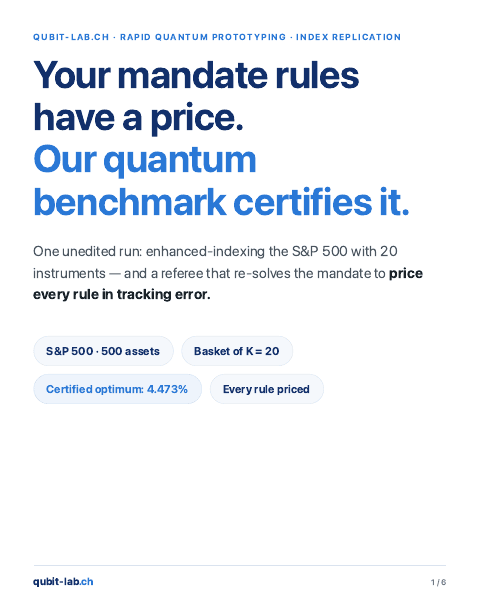
Your mandate rules have a price
S&P 500 replicated with 20 instruments at certified minimum tracking error — and every mandate rule priced by re-solving the optimum without it.
6 slides · ~3 minutes
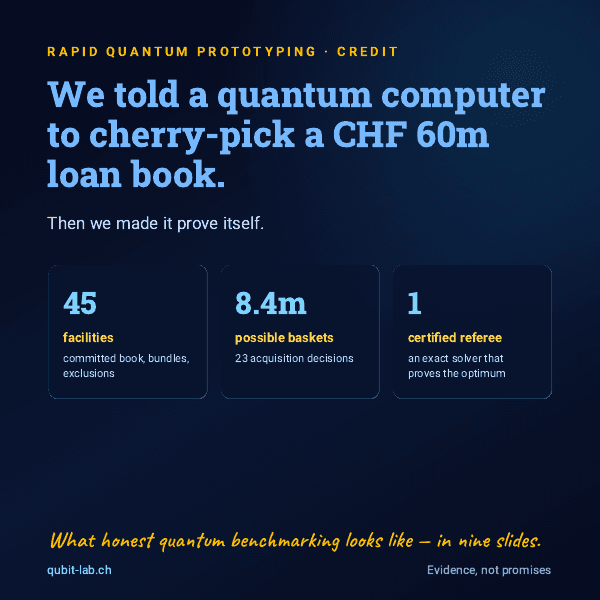
Credit allocation — the search for 0%
From a 1.07% gap to a certified 0.00% in measured steps, seeded and disclosed — the referee story behind the Credit Allocation RQP.
9 slides · ~3 minutes
Book a 30-minute call
A short conversation about your institution’s context and current questions — free, without obligation, and focused on your situation.